Before You Wheel: The Jeep Trail Safety and Recovery Checklist
Updated October 2026Most trail problems aren't bad luck. They come from good people using the wrong gear, or the right gear the wrong way, or heading out with a Jeep that had a problem nobody checked for. This guide covers what to check before you leave, the recovery gear to carry and how to use it safely, and how Kentucky trails are different. Read it before your first trail run, share it with your club, and print the checklist for the glovebox.
We're Heritage 4x4 Outfitters, a mobile Jeep mechanic in Louisville. We put this together because a trail day should end with everyone driving home.
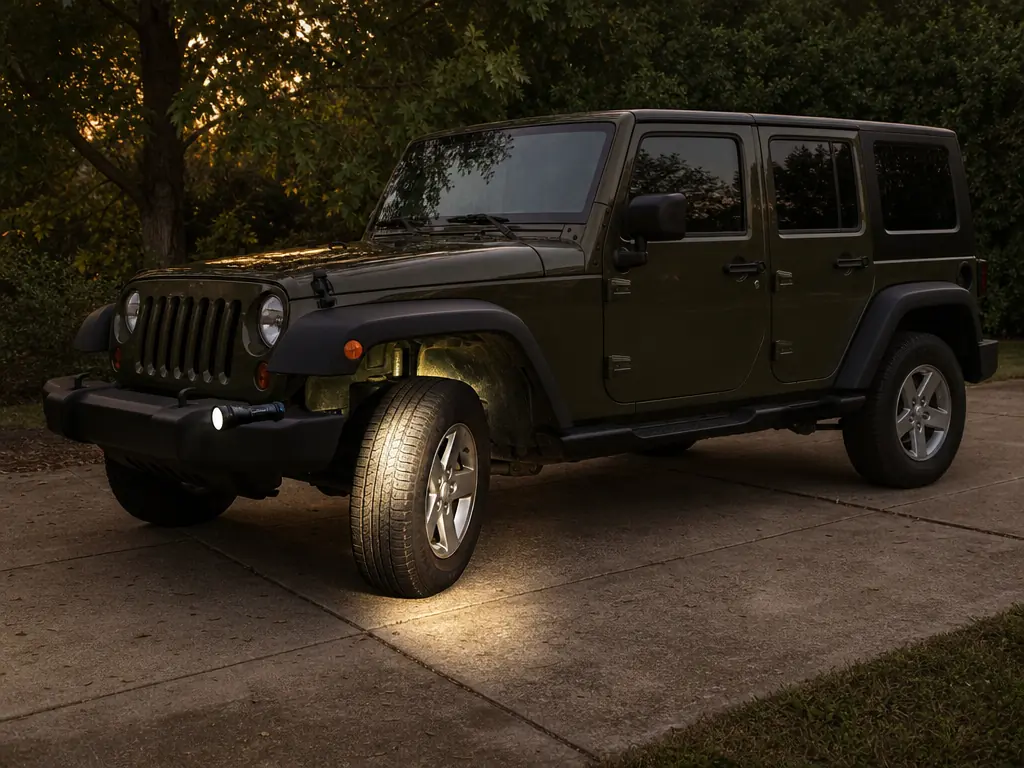
A Pre-Trail Jeep Check You Can Do in Your Driveway
The most common trail breakdowns start as small problems at home: a loose bolt, a worn steering joint, a slow leak. Twenty minutes in the driveway the week before a trail run catches most of them, and a week gives you time to fix what you find.
Steering and front end. With the Jeep running and parked, have someone turn the steering wheel back and forth a few inches while you watch the track bar ends, tie rod ends and drag link. Every part should move the moment the wheel moves. A clunk, or a joint that moves before the part it's attached to, is play, and play gets worse on the trail. It's also the usual start of death wobble. If you find any, get it looked at before the trip; our steering and ball joints page explains what's involved.
Wheels and tires. Check the lug nuts, especially if the wheels are new or were off recently. Look for cuts and bulges in the sidewalls. Make sure the spare holds air, fits over your brakes, and that you have a jack and lug wrench that actually work on your Jeep.
Fluids and leaks. Check the oil and coolant, then look under the Jeep for fresh drips. Make sure the axle and transfer case vent tubes are attached and routed up high; they matter at the first creek.
Brakes. Trail descents work your brakes hard. A soft pedal, grinding or a pull to one side should be fixed before you go. Our mobile brake repair page covers the signs.
Battery and winch. Make sure the battery is held down firmly and the terminals are tight. If you have a winch, spool out a few feet and back in, and check the rope or cable for fraying and the controller for a good connection.
Recovery points and anything new. Check that recovery points and bumper bolts are tight. If you've added a lift or new armor recently, recheck the bolts; parts settle in over the first few hundred miles.
If something on this list looks wrong, call before the trip, not from the trailhead.
Recovery Points, Straps and Shackles: What to Use and What Never to Use
More trail injuries come from recovery gear than from rollovers. Straps and shackles look alike, and people assume they're interchangeable. They aren't.
Kinetic Rope or Recovery Strap: Stretch Is the Point
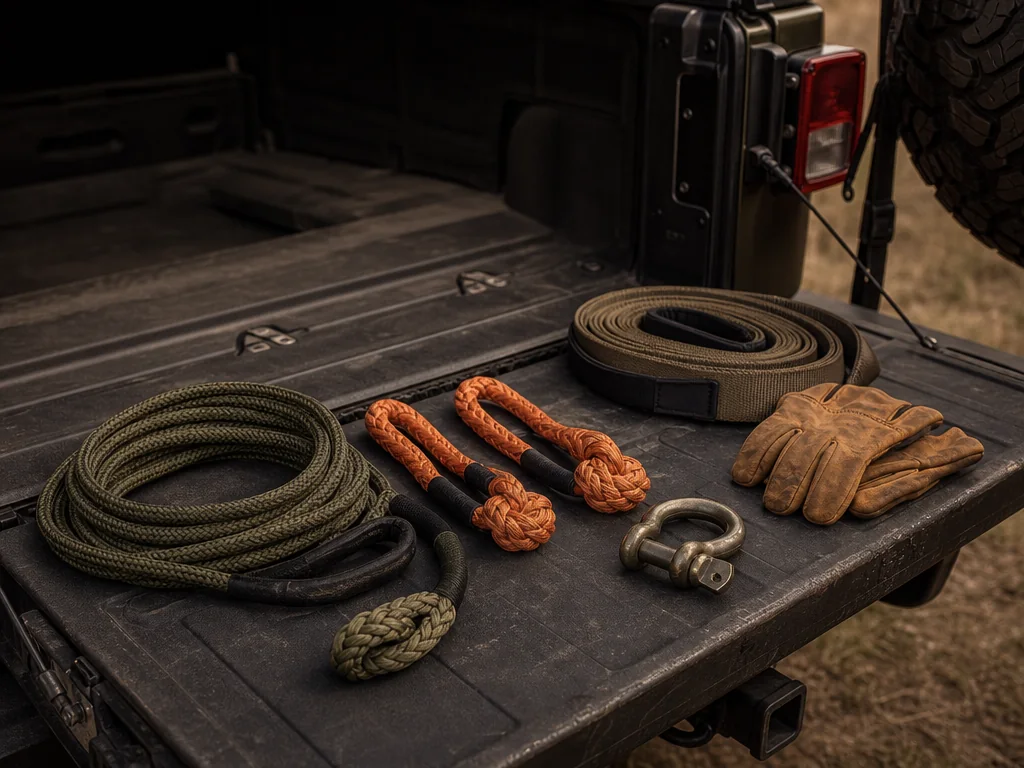
A kinetic recovery rope (or a snatch strap) is built to stretch. The pulling vehicle builds a little momentum, the rope stretches and stores that energy, then releases it gradually to pull the stuck Jeep free. Size it to your vehicle: most makers rate kinetic ropes at roughly two to three times the vehicle's weight, so follow the maker's sizing chart.
Tow Strap: Flat Ground Only
A tow strap barely stretches. It's for pulling a Jeep that's already free from point A to point B. Used for a yanking recovery, it sends the full shock of the pull straight into both vehicles' recovery points. That's how bumpers tear off and hardware turns into a projectile. Know which one is in your bag, and read the label instead of trusting the color.
Shackles
Use only rated, load-stamped shackles. A hardware-store D-ring is not a recovery shackle. Soft shackles (made of synthetic rope) are lighter and carry less risk if something lets go, but they still need a rating and should be retired when they're cut or badly worn. On a steel screw-pin shackle, thread the pin in fully, then back it off a quarter turn so it doesn't seize under load.
Rated Recovery Points
Attach only to points built for recovery: rated shackle mounts on a frame-mounted bumper, or a rated receiver shackle mount in a frame-mounted hitch. Many factory hooks and tie-downs are made for towing or shipping, not a hard kinetic pull. If you're not sure what yours are rated for, assume they aren't. Noah installs rated recovery points as part of our armor and recovery work.
Never attach a strap to a trailer hitch ball. A hitch ball isn't built for a recovery pull. Under a sudden load it can snap off and fly toward the other vehicle, and its windshield.
Never join two straps with a metal shackle. If something breaks, the shackle becomes a projectile. Loop the straps through each other instead, or use a soft shackle.
Winch Safety: The Rules for Every Pull
A winch can get you out of spots nothing else can. Used carelessly, it can snap a line, tear out a mount or hurt a bystander and still leave you stuck. These rules don't have exceptions.
Synthetic rope is the safer line. A steel cable stores a lot of energy under load, and if it breaks it whips. Synthetic rope is lighter and drops more like a rope when it breaks. Keep it off sharp rocks, and replace it when it's cut or badly worn.
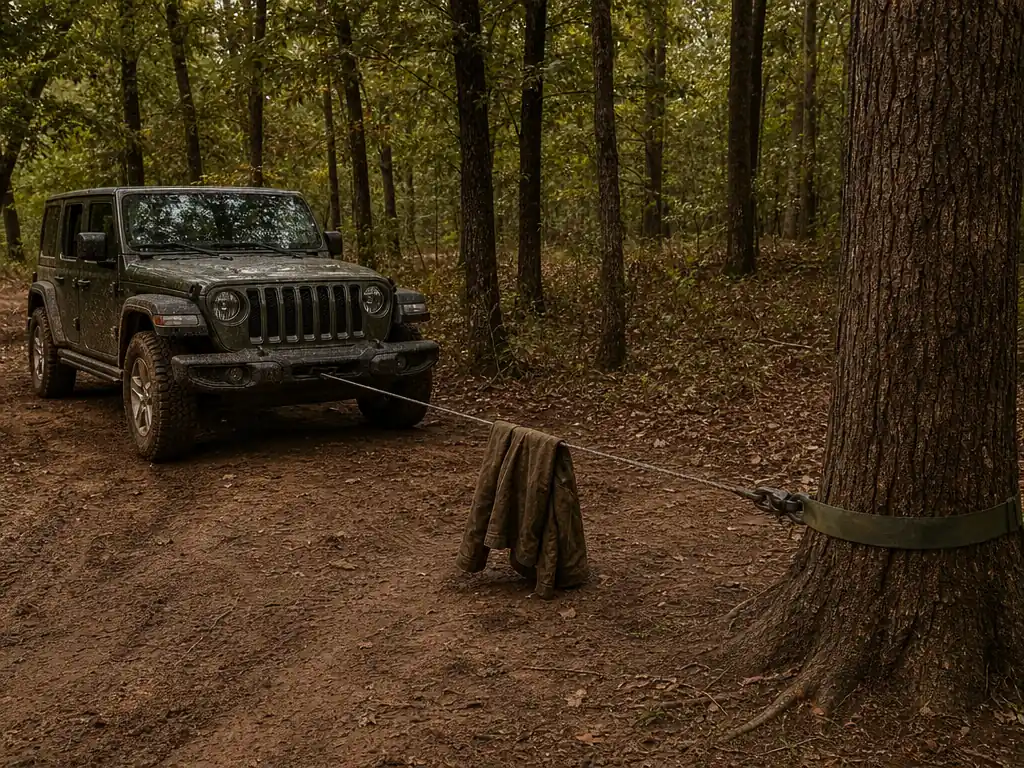
Put weight on the line. Drape a line dampener, or a heavy jacket in a pinch, over the middle of the line before the pull. If the line breaks, the weight pulls it to the ground.
Clear the area. Everyone who isn't running the winch stands well back, out to the side and never in line with the rope. Nobody steps over a line under tension, for any reason. Walk around the vehicle.
Use a tree saver. Never wrap the winch line around a tree. A wide tree saver strap goes around the tree and a rated shackle joins it to the line. It protects the tree and the rope.
Match every part to the winch. A shackle or strap rated for less than your winch can pull will be the first thing to break. Every piece of hardware should be rated for the winch's full pull.
Keep wraps on the drum. Never pull with the line spooled almost all the way out. Leave at least the minimum your winch's maker calls for; Warn's synthetic rope guide says never winch with fewer than 10 wraps on the drum.
Gloves on, hands clear. Wear heavy leather gloves when handling the line, use the hook strap when spooling, and keep your hands away from the fairlead.
Short pulls, engine running. Winch in short pulls and let the motor rest, and keep the engine running so the battery keeps up. A winch is for pulling a stuck vehicle, not for towing one.
Winch sizing, mounting and wiring are covered on our armor and recovery page.
Hi-Lift Jack Safety on the Trail
A hi-lift (farm jack) can lift a Jeep off a rock, help set a bead or work as a crude winch. It's also one of the easiest tools on the trail to get hurt with, because the handle stores energy under load and can snap up or drop without warning.
- Lift only from a hi-lift point. Most modern Jeeps don't have a factory spot a hi-lift can safely use. You need a bumper or rock sliders with hi-lift points, or a lift adapter that clamps to the wheel.
- Use a base. On dirt or mud, set the foot on a base plate or a square of thick plywood. A jack that sinks or tips mid-lift is the start of most hi-lift accidents.
- Stand to the side. Keep your head and body out of the handle's path. Keep the handle clipped to the bar when you're not actively pumping.
- Never get under it. A hi-lift is not a jack stand. Nobody goes under a Jeep that's held up by one.
- Keep it clean. Mud and rust keep the climbing pins from catching. Clean it, oil it lightly, and work it unloaded before the trip.
Spotting: How to Guide a Jeep Through an Obstacle
A good spotter gets a Jeep through a line that would otherwise end on its side. The system only works if everyone follows it.
- One spotter, one driver. Pick one spotter before the obstacle. Everyone else stays quiet. A driver hearing three people at once has no information.
- Agree on hand signals first. Stop, come forward, back up, turn left, turn right. Settle them before anyone climbs anything.
- The spotter can always stop the Jeep. When the spotter signals stop, the driver stops. No "just a little more."
- Eyes on the spotter. The driver watches the spotter, not the hood. The spotter can see the tires; the driver can't.
- Stay visible and stay clear. The spotter stays where the driver can see them and never stands where the Jeep could slide or roll onto them. Nobody stands below a Jeep on a climb or descent.
Kentucky Trail Conditions: Mud, Creek Crossings and Airing Down
Kentucky wheeling is mostly wooded hills, clay, rock ledges and creeks. That changes what you plan for.
Mud and Clay
Wet Kentucky clay turns slick fast and packs into tire treads. Go slow and steady, keep your wheels pointed where you want to go, and back out and try another line before you dig in. Some parks don't allow mud bogging at all.
Creek Crossings
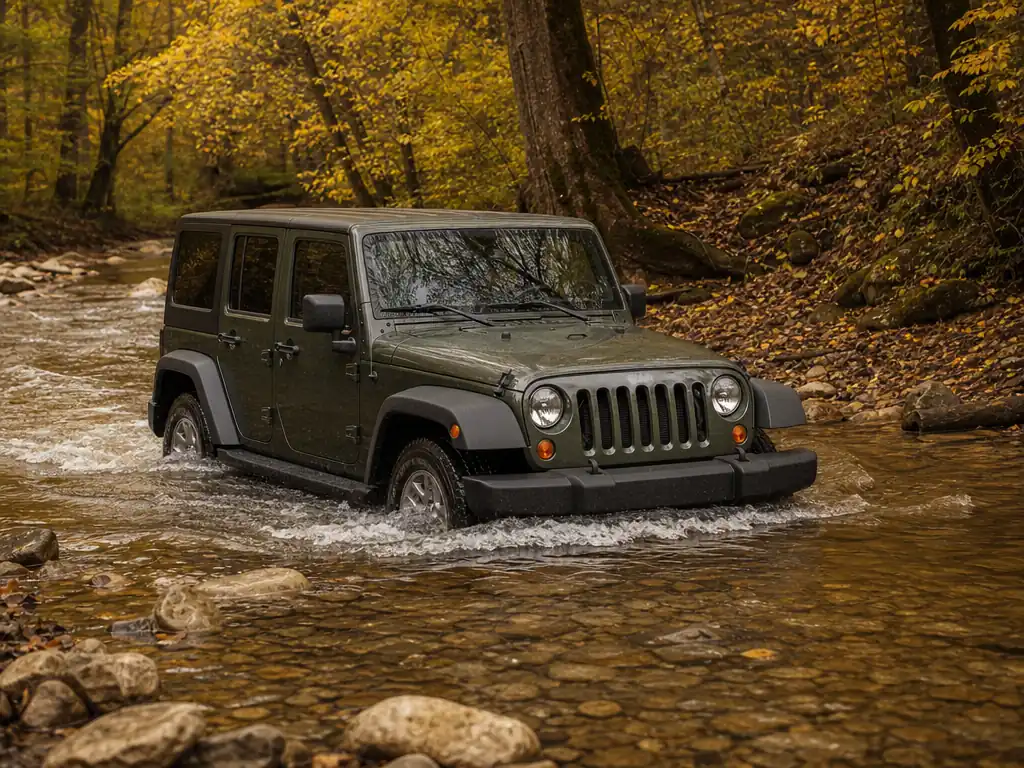
Walk a crossing first, or check its depth with a stick, before you drive it. Know your Jeep's rated water-fording depth; a JL Wrangler is rated for 30 inches at a slow 5 mph, and older Jeeps are rated for less. Cross slowly and steadily so the Jeep pushes a small bow wave. After heavy rain, creeks in the hollows can rise quickly. If the water is moving fast or you can't see the bottom, wait or turn around.
Airing Down
Lower tire pressure lets the tread spread out and grip, and it rides better over rock. How far down depends on your tires, wheels and Jeep, so start modestly and go lower in small steps; too low and a tire can come off the wheel. Carry a gauge and a compressor, and air back up before you drive on pavement.
Fall Leaves
Autumn leaves hide rocks, holes and stumps, so slow down on leaf-covered trails. Don't park over a pile of dry leaves or tall dry grass after a run; a hot exhaust or catalytic converter can set it on fire.
After the Trail
Hose the mud off the underside, especially around the brakes and steering. If you went through deep water, have the axle oil checked; milky fluid means water got in. Recheck the steering joints and bolts before your next drive to work.
Fire, First Aid and Trail Communication Without Cell Service
On the trail, help is a long way off. Plan as if you'll have to handle the first hour yourself.
Fire
Carry an ABC-rated fire extinguisher, at least 2.5 pounds, mounted where the driver can reach it, not buried under gear. Check its gauge before each trip. If you smell fuel or burning plastic, stop and find it before you drive on.
First Aid
Carry a real first aid kit, ideally with a tourniquet and gauze to control bleeding, and know how to use them. Bring more water than you think you'll need.
Communication
Don't count on your phone. In the Red River Gorge, the Wolfe County Search and Rescue chief has warned that cell signal is spotty and can't always be relied on, and many eastern Kentucky hollows are the same.
- Radios for the group. GMRS radios are a common choice for group trail runs. A GMRS license from the FCC costs $35, needs no exam, lasts 10 years and covers your immediate family. A ham radio license takes a 35-question exam and gets you much more range. FCC GMRS page
- A satellite messenger lets you send an SOS from places with no cell signal. On a remote trip, one per group is worth it.
- A float plan. Tell someone at home where you're going, when you'll be back and who to call if they don't hear from you.
- Offline maps. Download them before you leave, and carry a paper map as a backup.
The Trail Gear Checklist: What Every Jeep Should Carry
This isn't a sponsored list. Start here, and add more as your trails get harder or farther from home.
Recovery
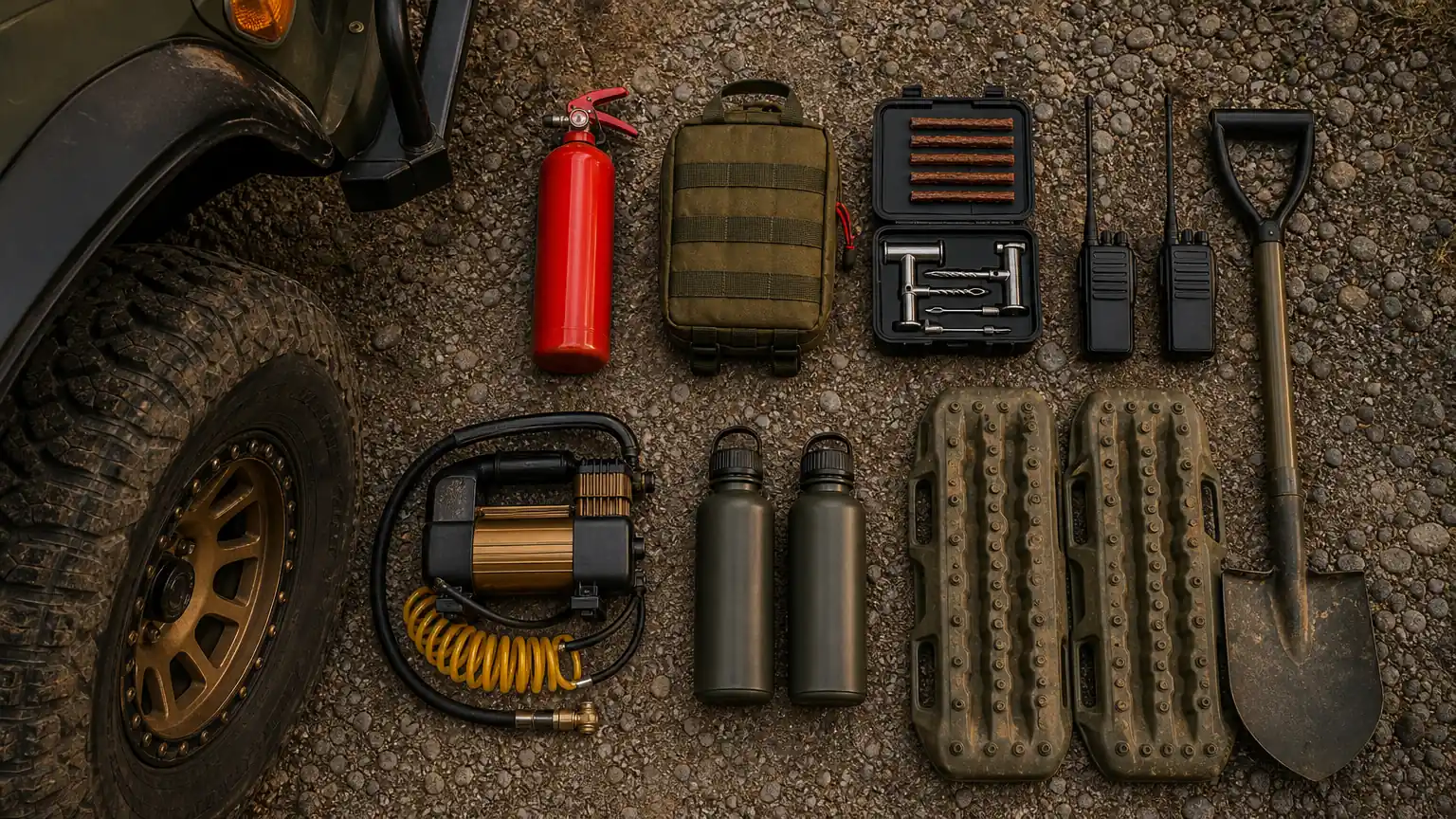
- Kinetic recovery rope sized to your Jeep
- Two or more rated shackles (soft or steel)
- Tree saver strap
- Line dampener or a heavy jacket
- Leather gloves
- Folding shovel
- Traction boards for mud and soft ground
- Hi-lift jack with a base, if your Jeep has hi-lift points
- Tow strap, for flat-ground towing only
Tools and Spares
- Basic hand tools that fit your Jeep
- Jack and lug wrench that work on your Jeep
- Inflated spare tire
- Tire plug kit and a portable compressor
- Tire pressure gauge
- Spare lug nut or two
- Zip ties, electrical tape and duct tape
- Jumper cables or a jump pack
- A quart of oil and a jug of coolant
Safety
- ABC fire extinguisher, 2.5 lb or larger, mounted within reach
- First aid kit with a tourniquet
- Plenty of water and some food
- Headlamp or flashlight
- Emergency blanket
- Charged battery pack for phones
Communication
- Charged phone with offline maps
- Paper map of the area
- Radios for the group (GMRS or ham)
- Satellite messenger for remote trips
- Float plan left with someone at home
Before You Leave
- Driveway check done (steering, tires, fluids, brakes, battery, winch)
- Park rules, permits and trail hours checked
- At least one other Jeep going with you
Trail Etiquette and Park Rules for Kentucky Off-Roading
Trails stay open when the people using them follow the rules and look after the land. Tread Lightly!'s five T.R.E.A.D. principles are a good place to start:
- Travel responsibly on designated routes and waterways.
- Respect the rights of others, including property owners and other trail users.
- Educate yourself: plan ahead and learn your equipment and the rules.
- Avoid sensitive areas like fragile habitat, water edges and historic sites.
- Do your part: set a good example and leave the trail better than you found it.
Tread Lightly! T.R.E.A.D. principles
On the trail, the vehicle going uphill usually has the right of way, because restarting on a climb is harder than backing up on a descent. Leave gates the way you found them. Never wheel alone.
Every park has its own rules, so check before you go. At Turkey Bay OHV Area in Land Between the Lakes, for example, every off-highway vehicle has to be registered with Land Between the Lakes before it's used there, riding is limited to sunrise to sunset, vehicles must stay on signed trails, and mud bogging is prohibited. LBL Turkey Bay OHV rules Kentucky Tourism keeps a list of off-road destinations around the state. Kentucky Tourism off-roading page For clubs, events and places Louisville Jeep owners wheel, see our Louisville Jeep community guide.
Jeep Trail Safety Questions
What recovery gear do I need for my first trail run?
For a beginner trail with a group, start with a kinetic recovery rope sized to your Jeep, two rated shackles, a tree saver strap, gloves, a shovel, a fire extinguisher, a first aid kit and a tire plug kit with a compressor. Your Jeep also needs rated recovery points to attach to. Most important of all, go with at least one other Jeep and someone who knows the trail.
What's the difference between a kinetic rope and a tow strap?
A kinetic rope stretches, stores energy and releases it gradually, which makes it the right tool for pulling a stuck Jeep free. A tow strap barely stretches and is only for towing a Jeep that's already free on flat ground. Using a tow strap for a yanking recovery can tear off recovery points and turn hardware into a projectile.
Can I hook a recovery strap to my trailer hitch ball?
No. A hitch ball isn't built for a recovery pull and can snap off under a sudden load. Use a rated receiver shackle mount in a frame-mounted hitch, or a rated recovery point on the bumper or frame.
Do I need a winch for my first trail run?
No. On most beginner trails, a group with rated recovery points and a kinetic rope can handle the usual stuck spots. A winch becomes worth it when you wheel harder trails, go out with fewer vehicles, or go where there's nobody to pull you out.
How much should I air down my Jeep's tires?
It depends on your tires, wheels and Jeep. Start modestly, go lower in small steps, and stop well before a tire risks coming off the wheel. Carry a gauge and a compressor, and air back up before you drive on pavement.
Do I need a license for trail radios?
For GMRS radios, yes. The FCC license costs $35, needs no exam, lasts 10 years and covers your immediate family. Ham radios need a ham license, which takes an exam.

Getting Your Jeep Trail-Ready in Louisville
If your driveway check turned something up, or you're ready to add gear, we come to you. Noah, the owner, works at your home or workplace on weekday evenings from 5 to 8pm and weekends from 8am to 8pm, within about 30 miles of Louisville, with no trip fee.
- Winches, bumpers, rated recovery points, sliders and skid plates, installed and tested in your driveway: see armor and recovery.
- Front-end play, worn joints and steering problems fixed before they become a trail-day breakdown: see steering and ball joints.
- Lift kits up to 3 inches, set up so the Jeep still drives straight: see lift kits and suspension.
- Your Jeep's own page: the TJ and LJ, JK and JL, Gladiator and XJ Cherokee.
Bigger jobs that need more than a driveway are by arrangement, so ask. Our how it works page walks through a visit from the first call to the walkthrough.
Go Out, Have Fun, and Bring the Jeep Home
The best recovery is the one you never need. Check the Jeep before you go, carry the right gear, wheel with friends, and know when to back off and pick another line. If something's wrong before the trip, tell Noah what it's doing and he'll come to you.