
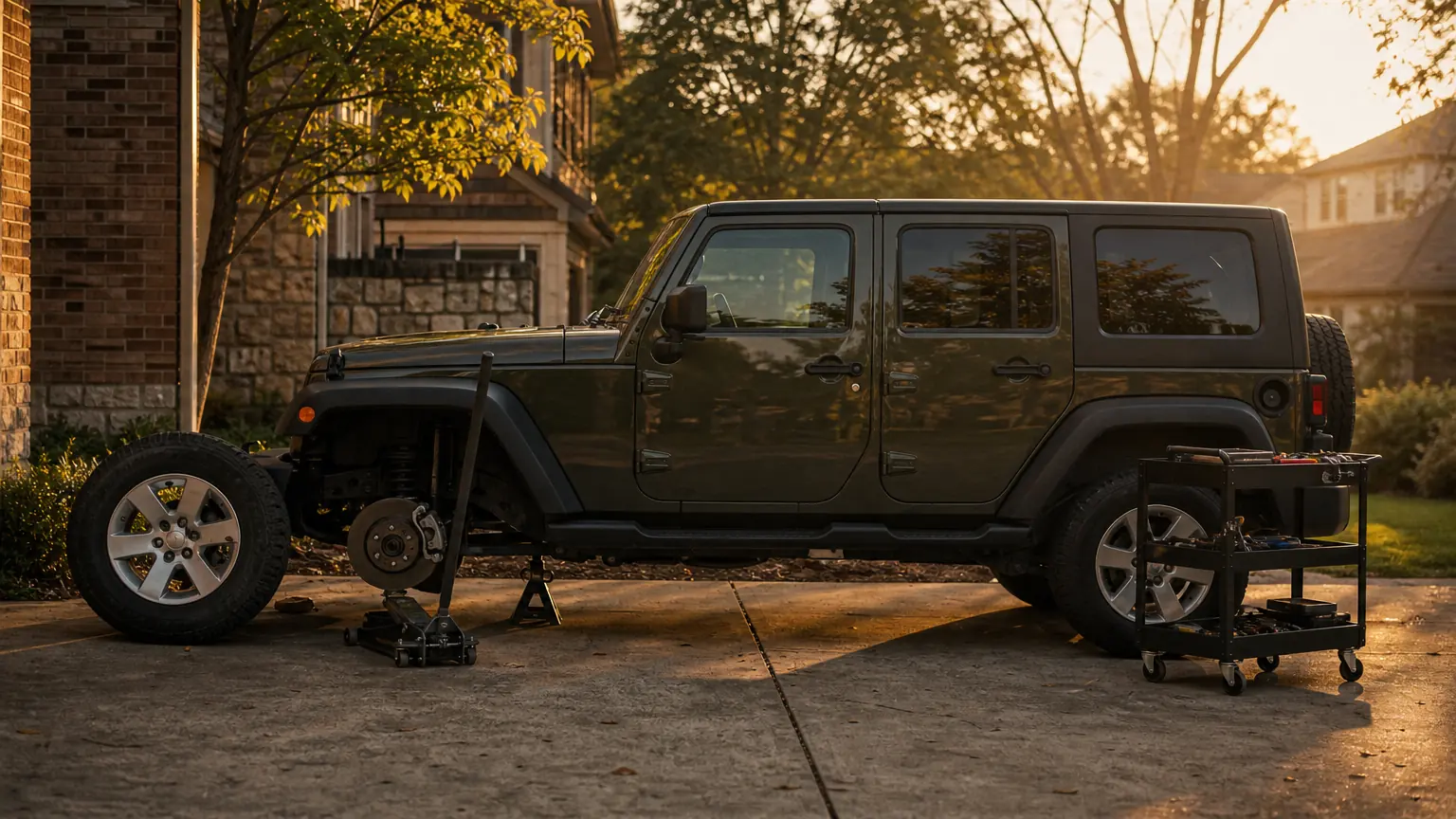
Ball Joint Replacement & Steering Repair for Jeeps, Trucks & SUVs
Updated October 2026Clunks over bumps, play in the steering wheel, a Jeep that wanders all over its lane: that's worn ball joints, a loose track bar or tired steering parts. Heritage 4x4 Outfitters does ball joint replacement and steering repair in your driveway across Louisville and Southern Indiana, on Jeeps, pickups and SUVs, on weekday evenings and weekends. If you've been searching for ball joint replacement near me or steering repair near me, you talk to Noah, the owner, and Noah does the work, with no trip fee.
Steering feels scary at highway speed? Slow down and keep it off the interstate until it's checked. If the front end shakes violently after a bump, that's death wobble; see our death wobble page for what to do right now.
Ball Joint Replacement Done Right — The Whole Front End, Checked Once
Steering parts wear together. The ball joints, track bar, tie rod ends, drag link and steering box all take the same potholes, the same bigger tires and the same miles. When one is worn enough to notice, the others are usually close behind. Replace only the loudest one and the steering still feels loose, because the play just moved to the next joint.
So Noah checks the whole front end on every steering job: every joint, bushing and mount, from the steering box to the wheel bearings. You hear what's worn, what's fine and what can wait, and you decide what gets replaced. Then it gets replaced in your driveway, with every bolt torqued to spec.
Steering Repair Options: Ball Joints, Track Bars, Tie Rods & Boxes
Checking the whole front end means knowing what each part does. Here's what we replace, and what each one feels like when it's worn.
Ball Joints
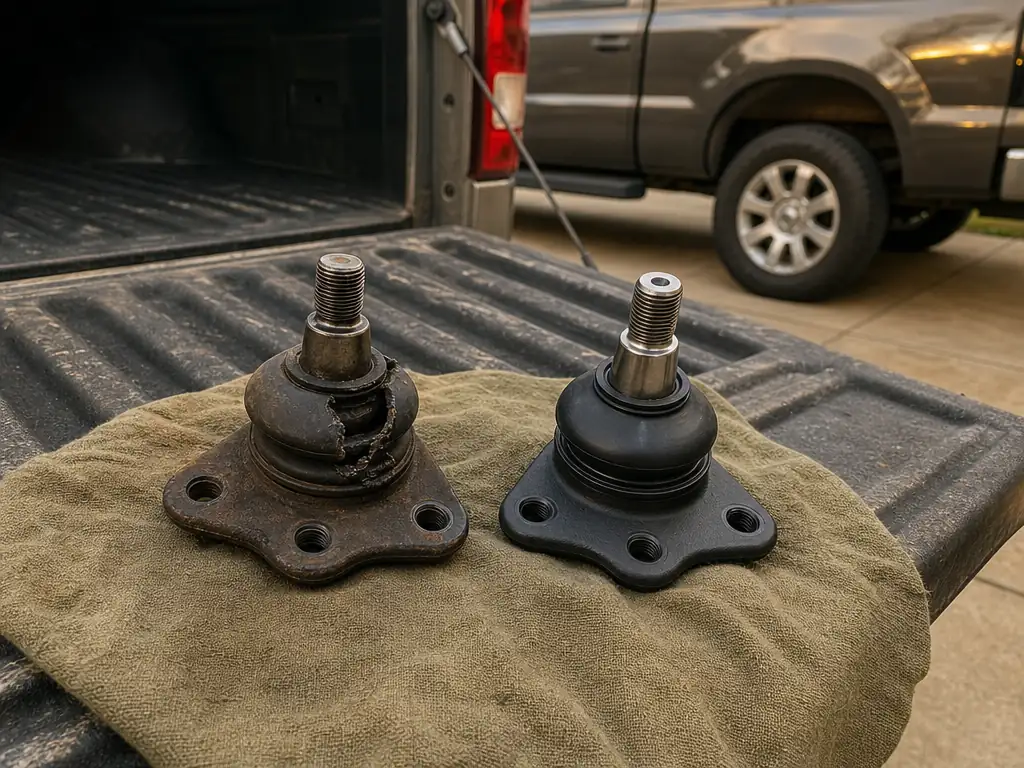
Ball joints are the pivots between the axle or control arms and the steering knuckles. They let the front wheels steer while the suspension moves up and down. A worn one lets the wheel rock on its pivot, which you feel as a clunk over bumps, a wandering front end and uneven wear on the front tires. On a solid-axle Jeep there's an upper and a lower ball joint at each front wheel, and they're pressed in and out with a ball joint press, right in your driveway.
Track Bar
The track bar runs from the frame to the axle and keeps a solid front axle centered side to side. When its bushings wear, or its bolt hole wears oval, the axle shifts sideways over every bump and the Jeep darts and wanders. Jeep track bar replacement is one of the most common front-end jobs we do, and on a lifted Jeep the fix is often an adjustable bar that re-centers the axle.
Tie Rod Ends and Drag Link
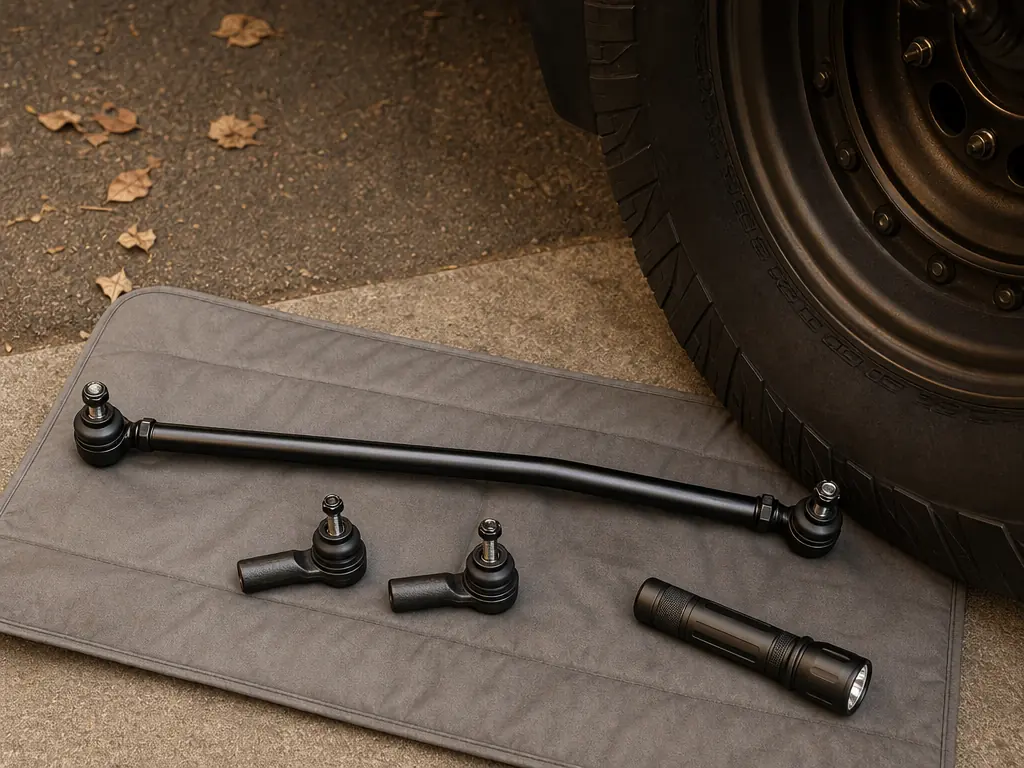
The tie rod connects the two front wheels so they steer together. The drag link connects the steering box to the wheels. Their ends are small ball joints of their own, and when they wear you get play in the steering wheel: a dead spot where you turn and nothing happens. Bigger, heavier tires wear them faster and can bend the factory tie rod on the trail.
Steering Box
The steering box turns the steering wheel's motion into the push and pull on the drag link. A worn or loose box gives you play right at the wheel and a Jeep that never quite holds a line. Jeep Wrangler steering box replacement is a bolt-on job, and sometimes the box only needs adjusting. We check the box mount too, because on older Jeeps the frame there can crack.
Steering Stabilizer
The stabilizer is a small shock absorber for the steering. It soaks up jolts before they reach your hands. A worn one is worth replacing, but a new stabilizer can't tighten loose parts; it only hides them for a while.
Heavy-Duty Steering Upgrades
Bigger tires put more force through the steering than the factory parts were built for. A heavy-duty upgrade, like Teraflex steering, replaces the tie rod and drag link with thicker, stronger parts that don't flex or bend. It's the usual fix for a Jeep on 35s that keeps wearing out factory steering.
Jeep Wrangler Loose Steering? Signs of Worn Ball Joints & Track Bars
Each of those parts warns you before it fails. If your Jeep Wrangler has loose steering, here's what the common signs usually point to.
Play in the steering wheel. You turn the wheel an inch or two and the Jeep doesn't respond. That points to tie rod ends, the drag link or the steering box.
Wandering and darting. The Jeep follows ruts and needs constant small corrections to stay in its lane. That's usually the track bar, worn ball joints or both.
A clunk over bumps or when you turn. A single knock from the front end points to a ball joint, a track bar bushing or a loose mount.
Uneven wear on the front tires. Wear on one edge of a tire means something up front has been loose or out of line for a while.
A shimmy after bumps that settles on its own. That's the early stage of death wobble. If it ever turns into a violent shake at highway speed, see our death wobble page.
A shake only when you brake. That's usually the brakes, not the steering; our mobile brake repair page covers it.
You can see some of this yourself. Park on level ground, set the parking brake, leave the engine running, and have a helper rock the steering wheel a few inches each way while you watch the front end with a flashlight from beside the Jeep, not under it. Any joint where one side moves before the other has play. If you'd rather skip it, finding the cause is what the $120 diagnostic is for.
Factory or Heavy-Duty Steering? A Louisville Jeep Owner's Guide
Once you know what's worn, the next choice is what to replace it with. Here's how we help owners decide.
Stock tires and mostly pavement: quality factory-style replacement parts are the right call. They cost less and last well when the tires are stock size.
Bigger tires, 33s or 35s: a heavy-duty tie rod and drag link are worth it. Factory steering flexes under bigger tires, and replacing it with the same parts means doing it again. Ball joints wear faster too, so heavier-duty joints make sense when they're due.
Lifted Jeeps: a lift tilts the track bar and can pull the axle off center, so an adjustable track bar often belongs in the steering job. Our lift kit installation page covers how a lift and the steering work together.
Heavy front bumper and winch: extra weight up front wears the steering and ball joints faster. If you're adding armor, plan the steering with it; see our winch and bumper installation page.
Pickups and SUVs: most need quality replacement parts rated for the truck's weight, not a heavy-duty upgrade, unless the truck is lifted and on much bigger tires.
Tell us how you drive and what tires you run, and Noah will tell you which parts are worth the money and which aren't.
Jeep Ball Joint Replacement Cost and Steering Repair Prices
With the parts chosen, here's what the work costs. Jeep ball joint replacement cost depends on how much of the front end is worn, which is why the price comes after the inspection.
- Full front-end steering on a Jeep: $2,000–$3,000. That covers ball joints, a track bar and a heavy-duty steering upgrade like Teraflex, depending on the parts your Jeep needs.
- Front-end steering and suspension on pickups and SUVs: from $1,200, parts and labor, for jobs like ball joints and tie rod ends.
- Single parts, like a track bar or a pair of tie rod ends, are quoted after we look, at $120 an hour for labor.
- Free quote when you already know what's worn, like ball joints that failed an inspection.
- Diagnostic: $120, when there's a clunk, a wander or play with no clear cause. You get the cause and a price before any repair.
- No trip fee anywhere in our service area.
Parts come from the same suppliers shops use, usually in 1–3 days, and Noah brings them to the job. Our labor carries a lifetime warranty, and parts carry their manufacturer's warranty, whether we supply them or you do. The details are in our terms and conditions.
The alignment afterward is done at an alignment shop, and we'll tell you before the job starts that you'll need one. With no storefront or front office to pay for, the price goes into the parts and the work.
Jeep Steering Explained: Ball Joints, Track Bar, Tie Rods & Box
The price makes more sense once you know how a Jeep steers, and why it wears the way it does.
A Wrangler, Gladiator or XJ has a solid front axle: one solid housing that carries both front wheels. The steering box bolts to the frame and turns a pitman arm. The pitman arm pushes the drag link, the drag link turns one wheel, and the tie rod turns the other wheel with it. The track bar holds the whole axle centered under the Jeep, and the ball joints let each wheel pivot to steer.
That's a lot of joints in a row, and the play in each one adds up. A little play at the box, a little at the drag link, a little at each tie rod end and ball joint, and the steering wheel has inches of slop before the tires move. That's why replacing one part rarely makes a worn Jeep feel tight again.
Bigger tires make every joint work harder. A heavier tire with a wider footprint takes more force to turn and hits bumps harder, and that force goes straight through the tie rod, the drag link and the ball joints. Lifts add angle, which tilts the track bar so the axle shifts sideways as the suspension moves.
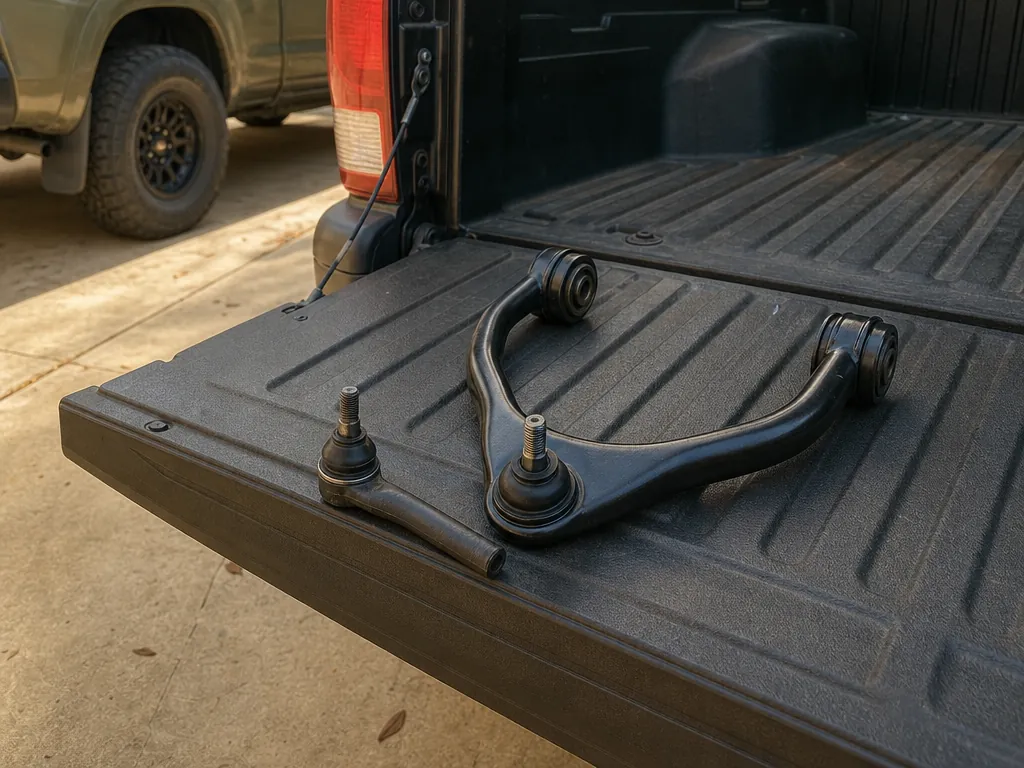
Most half-ton pickups and SUVs work differently. The F-150, Silverado 1500, Ram 1500, Tacoma, Tundra, 4Runner and Bronco have independent front suspension, with upper and lower control arms and a ball joint at each end. There's no track bar or drag link. Steering runs through a rack with inner and outer tie rod ends. The parts that wear are the ball joints, tie rod ends and control arm bushings, and the weight of a truck wears them steadily.
Ball Joint and Steering Repair by Vehicle: Jeeps, Pickups & SUVs
The same parts wear on every Jeep, but each generation has its own weak spots. Here's what we see most.
Jeep TJ Ball Joint Replacement and Steering Box Replacement (1997–2006)
On a TJ, age is the story: twenty-plus years of worn ball joints, tie rod ends, drag link and track bar bushings. Jeep TJ ball joint replacement usually comes with the rest of the front end, and Jeep TJ steering box replacement is common on high-mileage Jeeps with play at the wheel. We also look at the frame where the steering box bolts on, because TJ frames can crack there. If yours has, the frame repair needs welding and is by arrangement, so ask us. More on our TJ and LJ Wrangler page.
Jeep JK Ball Joint Replacement and Track Bar Replacement (2007–2018)
Jeep JK ball joint replacement is one of our most common jobs, especially on JKs lifted onto bigger tires. JK track bar bushings wear and the bolt hole at the frame can wear oval, so Jeep JK track bar replacement often goes with it. Factory JK tie rods and drag links flex on bigger tires, which is where a Teraflex heavy-duty upgrade earns its price. Jeep JK steering box replacement or adjustment comes up on high-mileage JKs with play at the wheel. More on our JK and JL Wrangler page.
Jeep JL Ball Joint Replacement (2018–present) and Gladiator (2020–present)
JLs and Gladiators are newer, so wear shows up first on Jeeps with bigger tires, lifts or regular trail use: ball joints, tie rod ends and track bar bushings. Jeep JL ball joint replacement on a lifted JL is usually paired with a check of the track bar and caster. The Gladiator is heavier and longer, so its front end works harder. If a 2018–2020 JL or a 2020 Gladiator has a front steering damper problem, check the settlement on our death wobble page first. More on our Gladiator page.
Cherokee XJ (1984–2001)
The XJ uses the same kind of steering as a TJ, and the same wear: ball joints, tie rod ends, drag link and track bar. The XJ is a unibody, so we check where the steering box mounts too; cracks there need welding and are by arrangement. More on our XJ Cherokee page.
Pickups and SUVs
On the F-150, Silverado 1500, Ram 1500, Tacoma, Tundra, 4Runner and Bronco, we replace upper and lower ball joints, inner and outer tie rod ends and worn control arm bushings, at your home or work. Front-end steering and suspension on pickups and SUVs starts at $1,200, parts and labor. Leveled and lifted trucks wear their ball joints faster, so we check them before and after any lift. Heavy-duty 2500 and 3500 pickups with solid front axles, like the Ram 2500 or F-250, steer much like a Jeep; ask us about yours, since one-ton steering is priced per truck. For everything else on a pickup or SUV, see our mobile truck mechanic page.
5 Ball Joint and Steering Repair Mistakes — And How We Avoid Them
Whatever you drive, these are the mistakes that bring a front end back for the same repair.
1. Replacing one part and calling it fixed
A new tie rod end on a Jeep with worn ball joints still wanders. How we avoid it: one full inspection, every worn part found, one quote.
2. Selling a stabilizer as the cure
A new steering stabilizer makes worn steering feel better for a few weeks, then the play is back. How we avoid it: we replace a worn stabilizer as part of the repair, never instead of it.
3. Ignoring the track bar mount
A new track bar in a worn, oval bolt hole will be loose again soon. How we avoid it: we check the mounts as well as the bar, and torque every bolt to spec.
4. Factory parts on a Jeep with much bigger tires
Factory-strength tie rods and drag links flex and bend under 35s. How we avoid it: we match the parts to your tires and tell you when heavy-duty steering is worth it, and when it isn't.
5. Skipping the alignment
New steering parts change the alignment, and a bad alignment wears tires unevenly and makes the steering pull. How we avoid it: we tell you before the job that you'll need one, and send you to an alignment shop afterward.
Steering Repair in Louisville, KY — Built for Potholes and Salt
Those mistakes catch up faster here, because Louisville roads are hard on a front end.
Potholes are the first reason. Kentucky winters swing above and below freezing again and again, and every freeze-thaw cycle opens new holes on I-64, I-65, I-71 and the Gene Snyder, and on side streets that don't get patched until spring. Every hard hit goes through the tie rods, the ball joints and the track bar. A front end that felt fine in November can feel loose by March.
Salt is the second. Road crews salt hard, and salt rusts tie rod adjusting sleeves, track bar bolts and steering box bolts until they seize. That's why steering work on an older Jeep or truck can take longer than the book says, and why we'd rather replace worn parts before the hardware rusts solid.
And most of us drive these roads every day, to work and back. A Jeep or truck with loose steering isn't one you want in rush-hour traffic on the Kennedy Bridge, and a shop repair means a tow or a nervous drive plus a lost day. That's why we fix steering where your vehicle is parked, on a weekday evening or a weekend, on both sides of the river.
How Our Mobile Ball Joint and Steering Repair Works
Here's how a steering repair goes, from the first call to the test drive.
1. Tell us what it's doing
Use the form or call (502) 557-6786 with the year and model, your tire size, and what you're feeling: play, wander, a clunk or a shimmy.
2. A quote or a diagnostic
If you already know what's worn, you get a free quote by phone or from photos. If it's a clunk or wander with no clear cause, Noah starts with the $120 diagnostic: a dry steering test, a check of every joint, bushing and mount, and a look at the tires.
3. Parts arrive
Noah orders the parts from the same suppliers shops use. They usually arrive in 1–3 days, and he brings them with him to the job.
4. The repair in your driveway
On a weekday evening or a weekend, at your home or work, on a level, paved spot with room to work around the front of the vehicle.
5. Test drive, walk-through and alignment
Every bolt torqued to spec, a test drive, and a look at the old parts. Then it goes to an alignment shop. The full process is on our how it works page.
Ball Joint Replacement Near Me — Questions, Answered
Who does ball joint replacement near me in Louisville?
Heritage 4x4 Outfitters replaces ball joints, track bars, tie rods and steering boxes on Jeeps, pickups and SUVs across Louisville and Southern Indiana, within about 30 miles. Noah, the owner, comes to your home or work on a weekday evening or a weekend and does the repair himself, with no trip fee.
How much does Jeep ball joint replacement cost?
It depends on what else is worn. Full front-end steering on a Jeep, with ball joints, a track bar and a heavy-duty steering upgrade, runs $2,000–$3,000. On pickups and SUVs, front-end steering and suspension starts at $1,200, parts and labor. Single parts are quoted after we look, at $120 an hour, and you get a price before any work starts.
How do I know if my ball joints are bad?
The usual signs are a clunk over bumps, a front end that wanders, and uneven wear on the front tires. With the front wheel off the ground and the vehicle on jack stands, a worn ball joint lets the tire rock when you push and pull at the top and bottom. If you're not sure, the $120 diagnostic finds it.
Is it safe to drive with bad ball joints?
Not for long. A ball joint that fails completely can let the wheel fold under the vehicle, and that's a crash at any speed. If you hear a clunk and feel the front end wander, keep it off the highway and have it checked soon. Because we come to you, there's no risky drive to a shop.
Will a new steering stabilizer fix loose steering?
No. A stabilizer soaks up jolts, but it doesn't tighten worn ball joints, tie rod ends or a loose track bar. It can make the steering feel better for a while, which hides the problem. Fix the worn parts, and replace the stabilizer too if it's worn.
Can you replace ball joints in my driveway?
Yes. Ball joints, track bars, tie rods, drag links and steering boxes are all driveway jobs. We need a level, paved spot with room around the front of the vehicle. The exceptions are a cracked frame at the steering box mount, which needs welding and is by arrangement, and the alignment afterward, which goes to an alignment shop.
Do I need an alignment after steering work?
Yes. New ball joints, tie rods or a track bar change the alignment, and skipping it wears tires and makes the steering pull. We'll tell you before the job starts, and you take it to an alignment shop afterward.
Should I upgrade to heavy-duty steering?
If you run 33-inch tires or bigger, or wheel your Jeep, usually yes. Factory tie rods and drag links flex and bend under bigger tires. On stock tires, quality factory-style parts are fine, and we'll tell you so.
Do you do steering repair on pickups and SUVs?
Yes. We replace ball joints, tie rod ends and control arm bushings on the F-150, Silverado 1500, Ram 1500, Tacoma, Tundra, 4Runner and Bronco. For heavy-duty pickups, ask us. We don't work on semis or commercial trucks, or on cars, minivans or crossovers.

Steering and Ball Joint Repair Across Louisville & Southern Indiana
We come to homes and workplaces within about 30 miles of Louisville. That covers Jefferson, Oldham, Bullitt, Shelby and Spencer counties in Kentucky, and Clark and Floyd counties in Indiana.
Brands We Trust
For Jeeps on bigger tires, our go-to heavy-duty steering is Teraflex: tie rods and drag links built thick enough that they don't flex or bend. For stock Jeeps, pickups and SUVs, we use quality replacement parts matched to the vehicle. We'll also install the parts you've already chosen.






Tight Steering Again, Fixed in Your Driveway
Every worn part found, a clear price before any work starts, and the repair done at your place on evenings and weekends, with no trip fee.