Lift Kit & Leveling Kit Installation for Jeeps, Trucks & SUVs — We Come to You
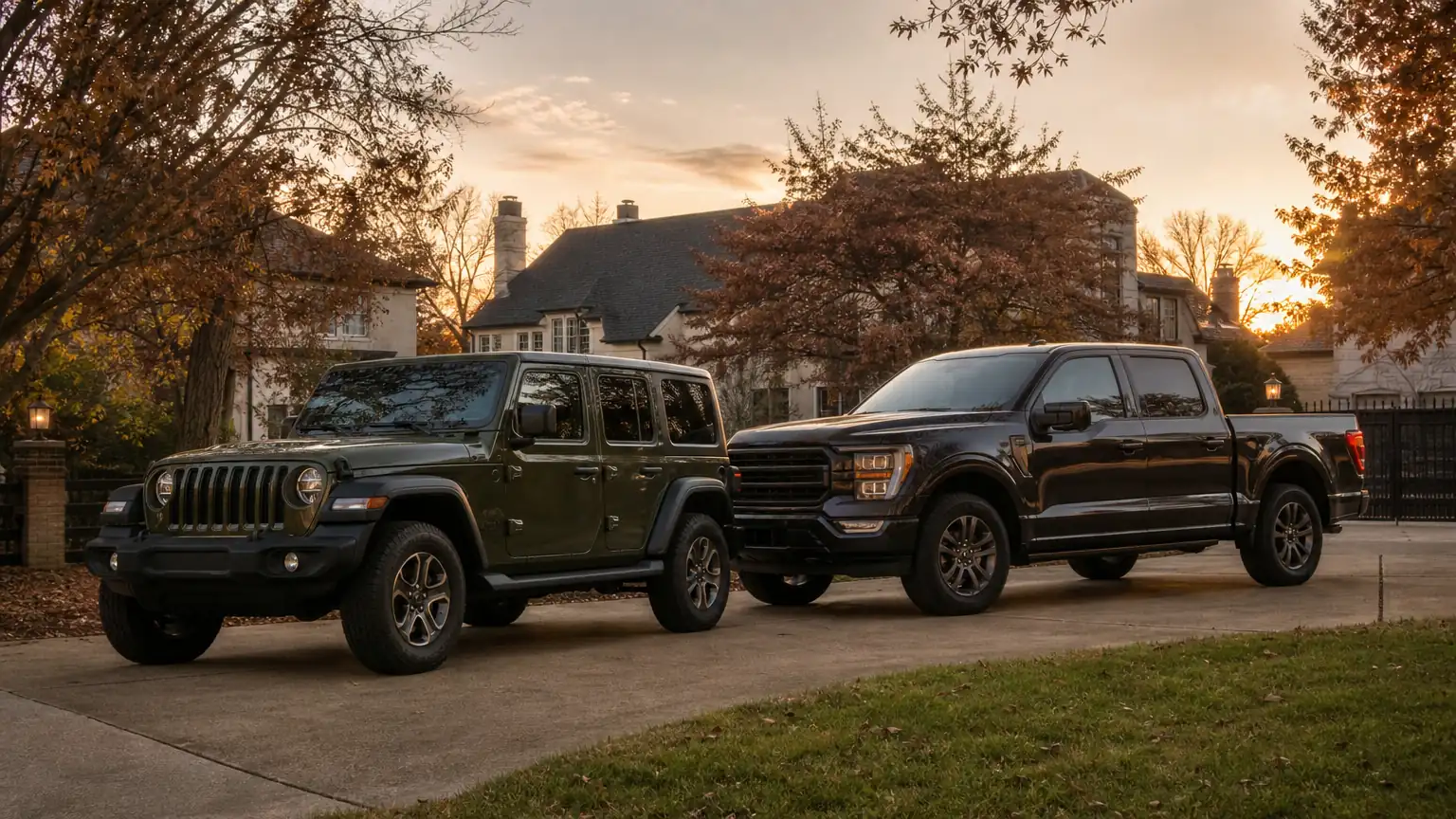
Updated October 2026Heritage 4x4 Outfitters does lift kit installation and leveling kit installation in your driveway, across Louisville and Southern Indiana, on weekday evenings and weekends. If you've been searching for lift kit installation near me, here's the short version: leveling kits and lifts up to 3 inches on Jeeps, pickups and SUVs, a free quote before anything is ordered, and no trip fee. Noah, the owner, does every install himself.
Lift Kit Installation Done Right — Geometry First, Height Second
Bolting on a lift is the easy part. The real job is making the Jeep or truck drive straight afterward. Raise a vehicle and you change the angles of everything between the axle and the frame: the track bar, the steering, the driveshafts and the brake lines. A lift that skips those details looks great parked and wanders or shakes on the highway.
So Noah checks the track bar and steering, makes sure the brake lines have slack at full droop, torques every bolt to spec and test drives it before he leaves. What isn't included: tires, and the alignment afterward, which is done at an alignment shop. And it all happens at your home or work, with no drop-off and no lost day.
Lift Kit and Leveling Kit Options: Leveling Kits, Spacer Lifts & Lifts up to 3"
With geometry first, here are the kits we install, from the simplest to the most involved.
Leveling Kits
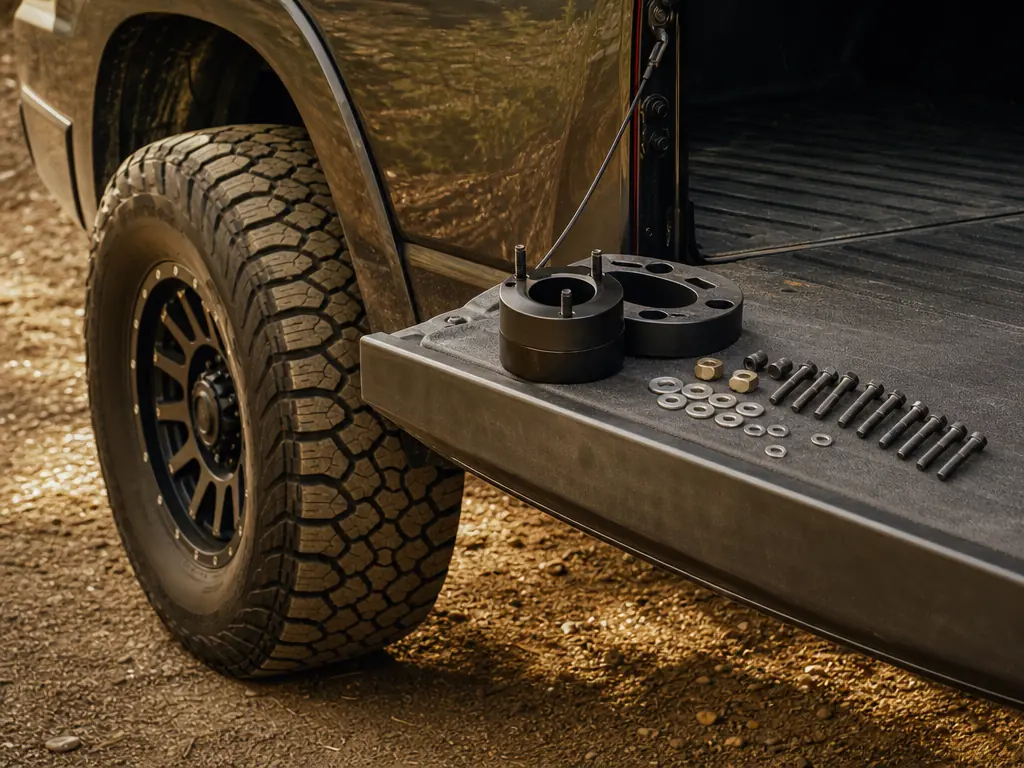
Most pickups and many SUVs sit lower in front than in back from the factory. A leveling kit raises the front, usually 1.5 to 2.5 inches, so the truck sits level and fits slightly bigger tires. On most trucks it's a set of spacers on top of the front struts. If you've been looking for leveling kit installation near me, it's the most common job we do on the F-150, Tacoma, 4Runner and Bronco. Adding bolt-ons too? See our truck accessories page.
Spacer Lifts
Spacer lifts raise the whole vehicle with spacers above the springs, front and rear, and keep the factory springs. They're the budget way to gain height and tire room, and the ride stays factory, for better or worse.
Suspension Lifts up to 3 Inches
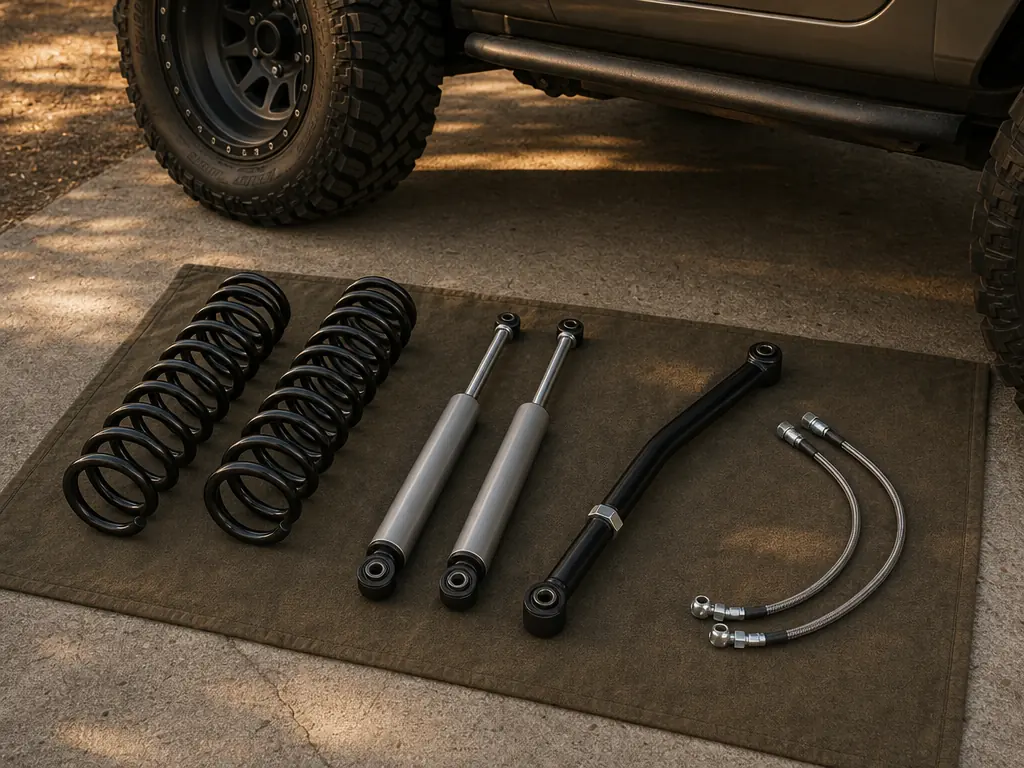
A suspension lift replaces the springs and shocks with taller, matched parts and adds what the height requires, like a track bar or longer brake lines. It's the best-riding way to gain height, and the usual choice for a Jeep that sees trails as well as the commute. On Jeeps, 2 to 2.5 inches is the most popular range.
Bigger Lifts
Bigger lifts and long arm kits need a shop floor, so they're by arrangement. Ask us.
What a Lift or Leveling Kit Unlocks — and the Tradeoffs
Whichever kit you choose, know what you gain and what changes before you buy.
What it unlocks: room for bigger tires (usually the real reason people lift), more ground clearance, better approach and departure angles on the trail, and a level stance on trucks that sit nose-down from the factory.
What changes:
- Steering feel. A poorly set-up lift can wander on the highway.
- Ride. Spacers keep the factory ride; new springs and shocks change it, often for the better.
- Vibration. Steeper driveshaft angles can cause a vibration at speed.
- Gearing. Bigger tires can make the vehicle feel slow. If your tire size calls for gears, ask us.
- Death wobble. On a solid-axle Jeep, a lift that skips the track bar and caster details is a classic cause of death wobble.
None of those are reasons not to lift. They're reasons to have it installed by someone who checks for them.
Leveling Kit or Lift Kit? How to Choose — A Louisville Owner's Guide
Knowing what changes makes the choice simpler: start with what you want the vehicle to do, then pick the smallest kit that gets you there.
A level stance and a little more tire: a leveling kit is usually all you need. It's the least expensive option and keeps the factory ride.
A daily driver with more height and bigger tires: a 2 to 3 inch spacer or suspension lift. On a Jeep that's usually enough for 33-inch tires, and on most trucks and SUVs it's the sweet spot between looks, clearance and ride.
Weekend trail use: a suspension lift with quality springs and shocks is worth the extra cost over spacers.
Pick your tire size first. The tire decides the lift height, and whether you'll want gearing later.
Jeeps and trucks lift differently. Wranglers, Gladiators and XJs have solid front axles located by control arms and a track bar, so their lifts are about recentering the axle and keeping the caster right. The F-150, Tacoma, 4Runner and Bronco have independent front suspension, so theirs are about the angles of the CV axles and control arms. Most daily drivers and weekend rigs are well served at 3 inches or under.
How Much Does Lift Kit Installation Cost?
Once you've picked a kit, the next question is how much to install a lift kit. Here's how we price it:
- Leveling kit installation: labor from $200.
- Lift kits up to 3 inches: labor from $800.
- The quote is free. Tell us the vehicle and the kit, send a few photos, and Noah quotes it by phone, or stops by if he needs to see it.
- No trip fee anywhere in our service area.
- The kit and parts are extra. We can order the kit from the same suppliers shops use, usually in 1–3 days, and Noah brings it to the install, or we can install one you've bought.
What moves the price: the vehicle, the kit type and height, and the extra parts a lift needs, like a track bar, longer brake lines or sway bar links. Truck leveling kit installation cost sits at the low end; Jeep lift kit installation cost runs higher because a solid axle needs more of those parts. The alignment afterward is separate, at an alignment shop. And with no storefront or showroom built into the bill, the price goes into the parts and the work.
What Changes When You Lift a Jeep or Truck — Track Bar, Caster, CV Angles & Brake Lines
Here's what the price pays attention to, kept to what matters at 3 inches and under.
On a Jeep, the track bar shifts the axle. The track bar runs from the frame to the axle and keeps the axle centered. Lift the Jeep and the bar sits at a steeper angle, pulling the axle toward one side. From about 2.5 inches up, most Jeeps need an adjustable track bar or a relocation bracket to center it again.
Caster keeps a Jeep tracking straight. Caster is the backward tilt of the line the front wheels steer around, and it pulls the steering back to center. A lift rotates a solid axle and reduces caster, which is why a lifted Jeep can wander. At 3 inches and under it's often fine, but it has to be checked.
Driveshaft angles get steeper. On older Jeeps like the TJ and XJ, that's a common cause of vibration at speed.
On trucks and SUVs, the CV axles take the angle. The F-150, Tacoma, 4Runner and Bronco drive their front wheels through CV axles, and a lift makes them run at a steeper angle. Push the front too high and the CV joints and boots wear fast, which is why front lifts on these trucks stay modest. Higher lifts also change the upper control arm and ball joint angles, which is why some kits include new upper control arms.
Brake lines have to reach. When a wheel hangs down over a dip, the brake hose stretches. Many lifts need longer lines, because a hose pulled tight can tear.
Steering parts work harder. Bigger tires add weight and leverage, so tie rods and ball joints wear faster. That's why we look at the steering on every lift; our steering and ball joint repair page covers the rest.
Jeep and Truck Lift Kit Installation by Vehicle
Those changes show up differently on each vehicle. Whether you're after Jeep lift kit installation or truck lift kit installation near me, here's what we install and what usually needs attention.
| Vehicle | Front suspension | What we install | What usually needs attention |
|---|---|---|---|
| Wrangler TJ (1997–2006) | Solid axle, coil springs | Spacer and spring lifts up to 3" | Driveshaft vibration, track bar, brake lines |
| Wrangler JK (2007–2018) | Solid axle, coil springs | Spacer and spring lifts up to 3" | Track bar to recenter the axle, caster, steering wear |
| Wrangler JL (2018–present) | Solid axle, coil springs | Leveling kits and lifts up to 3" | Adjustable track bar from about 2.5", sway bar links |
| Gladiator (2020–present) | Solid axle, coil springs | Leveling kits and lifts up to 3" | Same as the JL |
| Cherokee XJ (1984–2001) | Solid axle; leaf springs in back | Lifts up to 3" | Rear leaf springs, driveshaft vibration, worn bushings |
| Ford F-150 | Independent front, struts | Leveling kits and lifts up to 3" | CV axle angles |
| Toyota Tacoma | Independent front, struts | Leveling kits and lifts up to 3" | CV angles, rear lift to match |
| Toyota 4Runner | Independent front, struts | Leveling kits and lifts up to 3" | CV angles, rear springs to match |
| Ford Bronco | Independent front, struts | Leveling kits and lifts up to 3" | CV angles, rear lift to match |
Kits vary by year and trim, so we confirm fitment for your exact vehicle before anything is ordered.
Jeep lift kit installation is most of our lift work, with the JK and JL the biggest share; more on our TJ and LJ Wrangler, JK and JL Wrangler, Gladiator and XJ Cherokee pages. On the truck side, Tacoma lift kit installation, 4Runner lift kit installation and F-150 leveling kits come up most. Driving a different pickup? Ask us, or see our truck and SUV repair page.
5 Lift Kit Install Mistakes — And How We Avoid Them
The mistakes that make a lift drive badly are the same on every vehicle, and the first three are how a lifted Jeep ends up with death wobble.
1. Skipping the track bar
An off-center axle is loose over bumps. How we avoid it: we check centering on every Jeep lift and add an adjustable track bar or bracket when the height calls for one.
2. Ignoring caster
Low caster makes a lifted Jeep wander. How we avoid it: we check it, correct what the kit requires, and send you for an alignment afterward.
3. Reusing worn steering parts
A fresh lift on worn tie rods and ball joints is a wobble waiting to happen. How we avoid it: we check the steering first and tell you what's worn before you pay for anything.
4. Bigger tires without a plan
Tires too big for the lift rub, and tires big enough to strain the gearing make the vehicle sluggish. How we avoid it: we match the lift to the tire size you're planning.
5. Bolts not torqued to spec
A lift is dozens of bolts, and a few loose ones turn into clunks and wandering. How we avoid it: every bolt is torqued to spec before we leave.
Lift Kit Installation in Louisville, KY — Built for Kentucky Roads and Trails
Those mistakes catch up faster here, because Kentucky is hard on a lifted Jeep or truck.
Start with the roads. Louisville winters swing above and below freezing again and again, and every freeze-thaw cycle opens new potholes on I-64, I-65, I-71 and the Gene Snyder. A lifted vehicle on bigger tires hits them harder, which wears steering parts and loosens anything that wasn't torqued right. Road salt rusts lift hardware, brake lines and track bar bolts, so we check the lines you can't easily see.
Then there are the trails. The best-known places to wheel are a drive away: the Red River Gorge area in Powell County is about two hours east, Turkey Bay OHV Area at Land Between the Lakes is about three and a half hours west, and the bigger parks like Black Mountain are in far eastern Kentucky. Wooded hill climbs, rock and creek crossings are where a lift's clearance and tire room earn their keep. Looking for people to wheel with? See our Louisville Jeep community page.
And most of these Jeeps and trucks are daily drivers first. That's why we keep driveway lifts at 3 inches and under: enough for bigger tires and the trail, without giving up the commute.
How Our Mobile Lift and Leveling Kit Installation Works
Here's how a lift or leveling kit installation goes, from the first call to the test drive.
1. Tell us your goal
Use the form or call (502) 557-6786 with the vehicle, how you drive it and the tire size you want.
2. Get your free quote
Noah quotes it by phone or from photos, or stops by if he needs to see it.
3. Choose the kit
We order it for you, usually in 1–3 days, and Noah brings it to the install, or we install one you've bought from an established manufacturer that backs it with a warranty.
4. The install in your driveway
On a weekday evening or a weekend, at your home or work. All we need is a level, paved spot with room to work around the vehicle.
5. Check, test drive and alignment
Every bolt torqued to spec, the steering and brake lines checked, and a test drive. Then it goes to an alignment shop. Our mobile mechanic page covers everything else we fix at your place.
Lift Kit and Leveling Kit Installation Questions, Answered
Who does lift kit installation near me in Louisville?
Heritage 4x4 Outfitters installs leveling kits and lifts up to 3 inches on Jeeps, pickups and SUVs across Louisville and Southern Indiana, within about 30 miles. Noah, the owner, comes to your home or work on a weekday evening or a weekend and does the install himself, with no trip fee.
Who can install a leveling kit near me?
We can, in your driveway. Leveling kit installation labor starts at $200, the quote is free, and there's no trip fee. Most leveling kits on the F-150, Tacoma, 4Runner, Bronco and Wrangler are done in one visit.
How much does it cost to install a lift kit?
Labor for a lift up to 3 inches starts at $800, and leveling kits start at $200. The kit and parts are extra, and the alignment afterward is done separately at an alignment shop. You get a free quote for your exact vehicle and kit first.
How long does a lift kit installation take?
A leveling kit usually takes 2 to 4 hours. A lift up to 3 inches usually takes 3 to 6 hours, depending on the vehicle and the kit. Rusted hardware on older vehicles can add time, and we'll tell you if we expect that.
Can you install a lift kit in my driveway?
Yes. Leveling kits and lifts up to 3 inches are done in your driveway, on a level, paved spot with room to work. Bigger lifts and long arm kits need a shop floor, so they're by arrangement. Ask us.
Can I bring my own lift kit?
Yes, if it's from an established manufacturer that backs it with a warranty. We don't install no-name kits. Parts you supply carry their manufacturer's warranty, just like parts we supply, and our labor to install them carries our lifetime warranty. The details are in our terms and conditions.
Do I need an alignment after a lift or leveling kit?
Yes. Any change in ride height changes the alignment, and skipping it wears tires unevenly. We set up the lift so it can be aligned correctly, and you take it to an alignment shop afterward.
Will I need to regear after lifting my Jeep?
It depends on the tire size, not the lift height. Bigger, heavier tires change your effective gearing, which can make the Jeep feel slow and the transmission hunt for gears. If your tire size calls for gears, ask us.
Will a lift kit void my warranty?
Not automatically. Under a federal law, the Magnuson-Moss Warranty Act, a manufacturer can't void your whole warranty just because you installed aftermarket parts. It can deny a claim if it shows the part caused the problem, so suspension and steering repairs may not be covered. This isn't legal advice; check with your dealer if you're unsure.

Lift Kit Installation Across Louisville & Southern Indiana
We install lift and leveling kits at homes and workplaces within about 30 miles of Louisville. That covers Jefferson, Oldham, Bullitt, Shelby and Spencer counties in Kentucky, and Clark and Floyd counties in Indiana.
Brands We Trust
We install leveling kits and lifts up to 3 inches from brands that stand behind their parts: Teraflex, BDS, Rough Country, Skyjacker, Carli, ReadyLIFT, Superlift and Fabtech. Noah will tell you which suits your vehicle and how you drive it.






Ready to Lift Your Jeep or Truck?
Leveled or lifted in your driveway, by the owner, with a free quote and no trip fee.